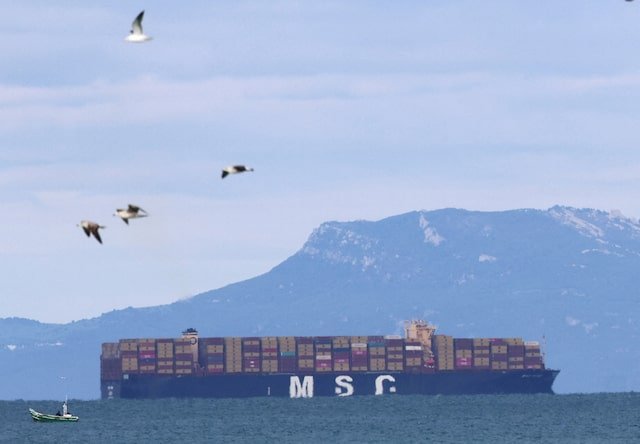
Companies supplying marine fuel along African coastlines are experiencing a notable surge in business as more vessels reroute around the Cape of Good Hope. The war in the Middle East has reshaped global shipping routes and strengthened Africa’s role as a key refuelling hub.
Shipping firms have been avoiding the Suez Canal and the Bab el-Mandeb Strait since late 2023, when Houthi attacks on Red Sea shipping began. U.S. and Israeli strikes on Iran, along with the closure of the Strait of Hormuz, have reinforced this shift, fuelling expectations that Africa’s bunkering sector will benefit from prolonged instability.
Major container shipping companies, including Maersk, Hapag-Lloyd, and CMA CGM, announced this month that they are rerouting vessels around the Cape of Good Hope.
While this rerouting extends voyage times, it allows ships to refuel at emerging African supply points, accelerating investments by fuel suppliers and trading firms.
Existing African suppliers, such as Monjasa, report increased demand in recent years. Meanwhile, new entrants—including Vitol, Bunker Partner, Peninsula, Flex Commodities, and Global Fuel Supply—have announced expansion plans.
Thorstein Andreasen, spokesperson for Monjasa, said volumes have been positively impacted by the security situation in the Red Sea, which has pushed more vessels to reroute south of Africa.
Monjasa, which has operated in West Africa for nearly two decades, also reported an additional spike in bunkering activity during the first week of the Iran conflict.
“Regardless of how the conflict ends, we expect volatility to remain high for a prolonged period,” Andreasen said. Trade data indicate that vessel diversions rose by 112% through early March, suggesting what shipping firms increasingly view as a structural shift rather than a temporary adjustment.
Bhavan Vempati, head of ocean market operations for Asia at Maersk, said: “After nearly two years of operating under these conditions, it is difficult to describe our system as temporary—it has become an adaptation to a new operational reality.”
He added that Maersk now routinely conducts bunkering operations at West African ports and in Tangier. This trend has encouraged new market entrants. In November, Flex Commodities launched bunkering services in Walvis Bay and Lüderitz.
Rakesh Sharma, managing partner at Flex, said: “We are targeting the growing traffic around the Cape of Good Hope and the regional maritime market, offering an alternative to traditional bunkering hubs.” He added that the company is initially focusing on West Africa, where supply still lags demand, particularly offshore.
Moses Komudatam, operations manager at Mesa Energy, a bunkering operator in Ghana, said the company is expanding volumes to meet rising demand in offshore bunkering zones. He expects bunkering volumes in Ghana to triple in the coming period.
Tahira Sargent, regional director for Africa at the International Bunker Industry Association, noted that long-term growth prospects extend beyond geopolitical disruptions, supported by regional and intra-African trade, port infrastructure investments, and Africa’s strategic location on global shipping routes.
At a conference in March last year, the Mauritius Ports Authority reported that total marine fuel sales at Port Louis nearly doubled, reaching a record 929,043 metric tonnes in 2024, up from 509,837 tonnes the previous year.
Industry sources warn, however, that Africa’s bunkering sector still faces challenges, including piracy, limited infrastructure, and supply uncertainty linked to the closure of the Strait of Hormuz, which constrains fuel exports from the Middle East.
Emril Jamil, senior analyst at London Stock Exchange Group, said: “With reduced crude supply and refinery run cuts, fuel oil availability across all bunkering hubs is expected to tighten.”
Komudatam added that infrastructure bottlenecks—such as congestion at Tema Port—and high product costs due to tax regimes remain long-term challenges. Regulatory and licensing disputes also continue to create uncertainty.