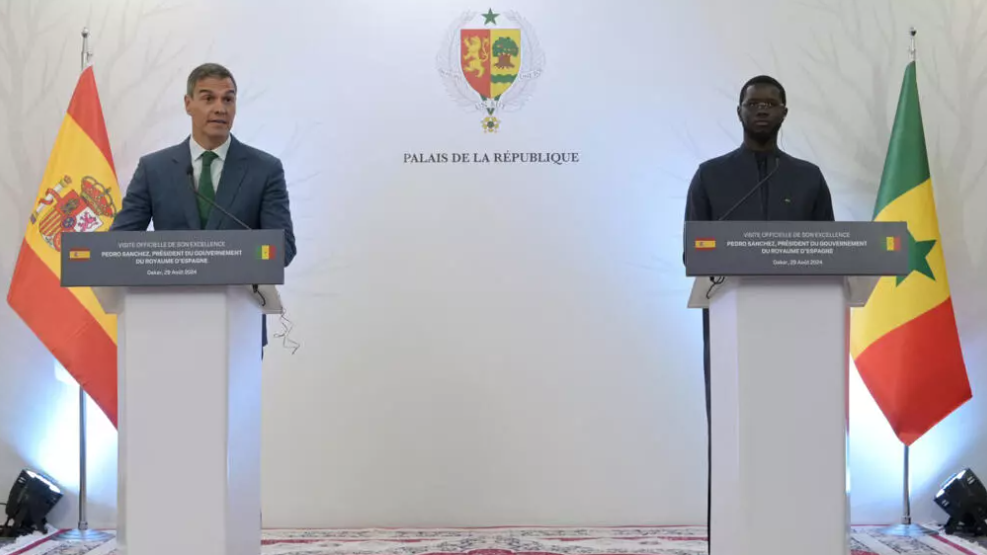
Senegalese President Bassirou Diomaye Faye arrived in the Spanish capital, Madrid, on March 24 for his first state visit to Spain since taking office, in a move reflecting both countries’ desire to strengthen bilateral relations and expand areas of joint cooperation.
The two-day visit is expected to include official meetings with King Felipe VI and Prime Minister Pedro Sánchez. Discussions will focus on advancing economic partnership and enhancing cooperation across several key sectors.
Spain is Senegal’s fourth-largest trading partner, following China and France, giving the visit particular importance within the broader context of economic ties between the two countries.
President Faye is accompanied by Minister of Economy Abdourahmane Sarr, as part of efforts to boost trade exchanges and attract further investment. The Senegalese president is also expected to participate in a business forum organized by the Spanish Chamber of Commerce on March 25, aimed at opening new opportunities for Spanish companies in the Senegalese market. This comes as Dakar seeks to attract investors, while Madrid looks to expand its corporate footprint in Africa.
This momentum is supported by the “Africa Forward Alliance” initiative, a strategy launched by Spain in August 2024 to strengthen its investment presence across the African continent. Current data indicates that around 70 Spanish companies are already operating in Senegal, with expectations of further growth in the near term.
Talks are also expected to address seasonal migration, a key pillar of cooperation between the two countries. The program, supported by Spain, allows hundreds of Senegalese workers to take up seasonal employment for up to nine months each year.
For its part, the Senegalese government is seeking to increase its 2025 quota for agricultural workers—currently set at 500—in an effort to expand employment opportunities for its citizens abroad.