
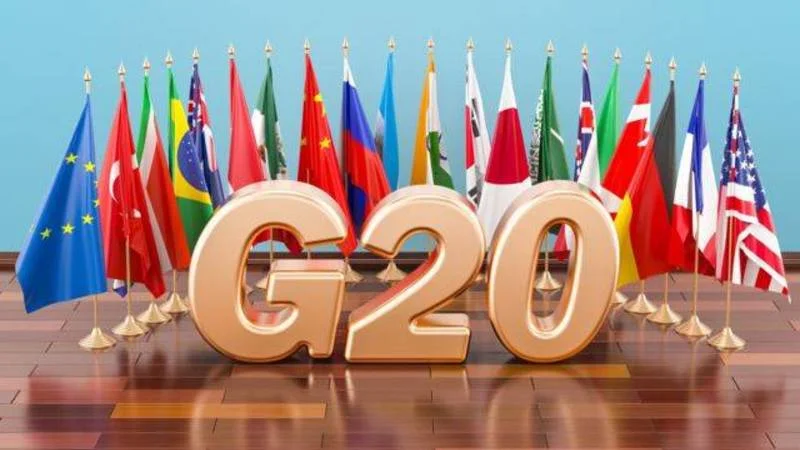
South Africa announced, on the sidelines of its participation in the World Economic Forum in Davos, Switzerland (19–23 January 2026), a temporary suspension of its participation in the Group of Twenty (G20), in a notable move that coincides with the United States assuming the bloc’s rotating presidency until the end of 2026.
Kofi Kwako, a lecturer at the School of Governance at the University of the Witwatersrand in Johannesburg, said the decision comes as part of Pretoria’s efforts to avoid potential friction with Washington, explaining that “South Africa seeks to avoid crises or tensions with the United States, which is a rational choice at this time.”
This development comes against the backdrop of earlier political tensions, as U.S. President Donald Trump had boycotted the G20 summit hosted by South Africa last November, accusing Pretoria of pursuing policies he described as hostile to U.S. interests.
About two months ago, South Africa had announced the suspension of its participation in the 2026 G20 summit for a full year, before this suspension evolved into an actual temporary withdrawal from the group, which brings together the world’s twenty largest economies.
As a result, the G20 in 2026 is witnessing an exceptional and rare situation, effectively becoming a “G19” in the absence of one of its key members.
Observers believe the move indirectly reflects Pretoria’s اعتراض to the political climate that has come to dominate the group under the U.S. presidency, which several parties describe as increasingly tense and confrontational.
In this context, Kwako stressed that the South African decision is consistent and wise, saying: “The G20 was created to bring together all countries of the world, not only those we like or those that resemble us politically. This spirit is now being undermined. It is unfortunate, but South Africa has chosen to protect its interests and avoid a confrontation with the United States.”
Despite Pretoria’s insistence that the withdrawal is temporary, its repercussions could be tangible, particularly with regard to Africa’s representation within the group. Kwako warned that South Africa’s absence would leave a political and representational vacuum, noting that “South Africa and the African Union together represent around 1.4 billion people. South Africa’s withdrawal creates a vacuum for Africa and for its representation within the G20.”
Britain is scheduled to assume the G20 presidency next year, a development that could open the door for South Africa’s return to the table of major economies, should a calmer and more consensual diplomatic climate emerge, as Pretoria hopes.