African Center for Consultancy
Since gaining independence from Belgium in 1960, the Congo has been trapped in a cycle of continuous political and security crises. The most notable events include the assassination of nationalist leader Patrice Lumumba, the secession of resource-rich provinces, and the coup led by General Mobutu, who ruled the country with an iron fist for decades. In the 1990s, the Congo turned into a battlefield for regional conflicts, with two bloody wars—known as the “Congolese Wars”—that left millions dead and displaced. Despite the signing of a peace agreement in 2003, the country failed to escape the spiral of violence. Eastern Congo has remained a recurring hotspot for armed conflicts, driven by weak state institutions and interventions from regional powers, particularly Rwanda and Uganda. This brief historical background sets the stage for understanding today’s renewed crisis, which continues a long legacy of instability.
The recent events trace back to 2021, when armed groups re-emerged in the provinces of Kivu and Ituri, led by the Allied Democratic Forces (ADF) and the March 23 Movement (M23), which had been defeated in 2013. By 2022–2023, the movement gradually regained strength, amid direct accusations against Rwanda of providing it with military and logistical support. This escalation coincided with the Congolese government’s inability to assert control, despite President Félix Tshisekedi’s declaration of a state of emergency in the east and the deployment of the army.
By early 2024, the crisis entered a more dangerous phase. UN reports confirmed that M23 had captured major towns north of Goma, causing new waves of displacement that pushed the number of internally displaced persons in Congo to over 7 million—the highest figure in the country’s modern history. At the same time, attacks on civilians intensified, including mass killings and systematic sexual violence, which international organizations described as “crimes against humanity.”
In January 2025, the situation escalated to unprecedented levels when M23 forces stormed the city of Goma, one of eastern Congo’s most important urban centers, before expanding in February toward Bukavu. This shocked both local and international communities, while forcing the UN to reconsider the role of its peacekeeping mission (MONUSCO), which had already begun scaling down its presence. In the following months, the humanitarian crisis reached catastrophic levels: more than 25 million people were left in urgent need of assistance, while human rights groups recorded a sharp increase in cases of sexual violence.
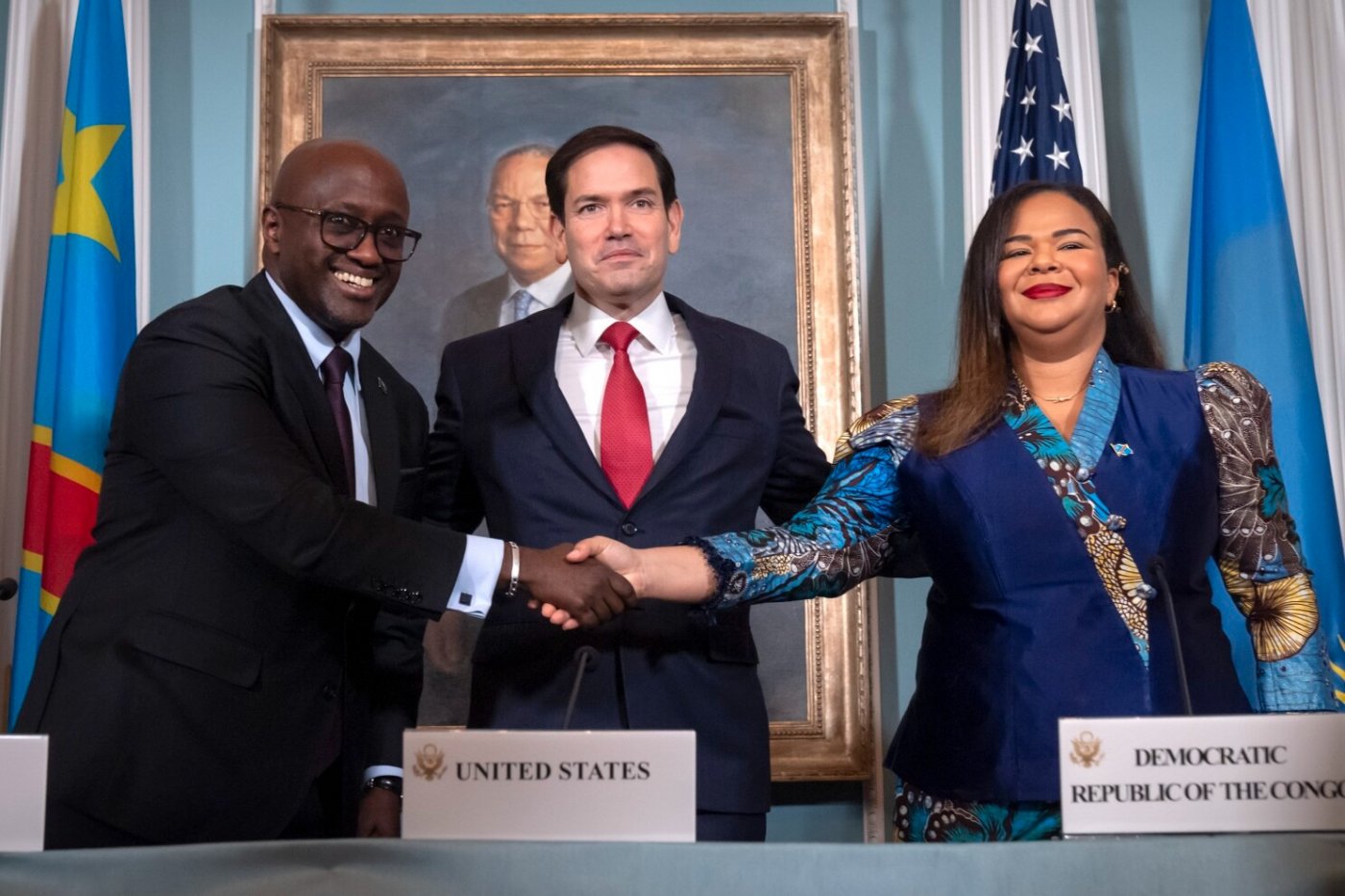
Amid this humanitarian tragedy, diplomatic efforts gained momentum to find a political solution. Under U.S. sponsorship, a series of meetings between the Congolese and Rwandan governments culminated in June 2025 with the signing of the “Washington Agreement.” Under the accord, Kinshasa and Kigali committed to respecting each other’s sovereignty and territorial integrity, halting support for cross-border armed groups, and establishing a joint monitoring mechanism with the African Union, Qatar, and the United States as guarantors.
Despite doubts, the agreement marks a significant turning point, as it reopened the door to regional dialogue and, for the first time, placed explicit obligations on Rwanda to halt its support for rebels—a demand Congo had been pressing for years. The accord also initiated talks on the return of displaced persons and on strengthening oversight of the trade in rare minerals that fuel the conflict. However, many observers remain skeptical about its ability to change realities on the ground unless the rebels are integrated into a comprehensive peace process and the state strengthens its presence in the east.
On a parallel track, in April 2025, with Qatari mediation in Doha, the Democratic Republic of Congo and the M23 movement issued—for the first time—a joint statement affirming their commitment to an immediate cessation of hostilities and rejecting all hate speech and threats. This represented the beginning of a new negotiation path to end the cycle of conflict in the east. These efforts culminated in the signing of a Declaration of Principles in Doha on July 19 of the same year, attended by representatives from the African Union and the United Nations. The agreement stipulated a permanent renunciation of the use of force, the establishment of a joint mechanism to monitor the ceasefire, the exchange of prisoners, guarantees for the safe return of displaced persons and refugees, the strengthening of state authority in rebel-controlled areas, and renewed commitment to reject all forms of hate speech.
Several potential scenarios emerge. The first is the stabilization scenario, whereby the agreements succeed if Rwanda truly halts its support for armed groups and M23 engages in the political process. The second is a breakdown of the agreement if M23 maintains its territorial control without withdrawal, undermining international confidence. Conversely, the risk of regional escalation remains if cross-border interventions resume and monitoring mechanisms fail, potentially opening the door to a wider war.
The crisis also faces several key challenges, foremost among them the weakness of Congolese state institutions in the east, the lack of mutual trust between Kinshasa and Kigali, the complexities of the war economy linked to rare minerals, and the heavy humanitarian toll of millions displaced.
Yet, there are important opportunities. Chief among them are the existence of international and regional frameworks such as the Washington and Doha processes, which provide multiple guarantees; the inclusion of returnees and refugees in the agreements; and the international community’s interest in reducing conflict hotspots that fuel extremist groups.
Today, the Congolese scene stands at a crossroads. On the one hand, there is a political agreement seeking to halt the bloodshed and establish regional understandings. On the other, there is a grim humanitarian reality with millions displaced and little prospect of rapid stabilization. Between international pressure and the hesitancy of some parties to fully commit to the agreements, Congo’s future hinges on its ability to transform written understandings into tangible measures that can bring an end to one of Africa’s longest and bloodiest crises in modern times.