
African Center for Consultancy
March 2026
I. Executive Summary
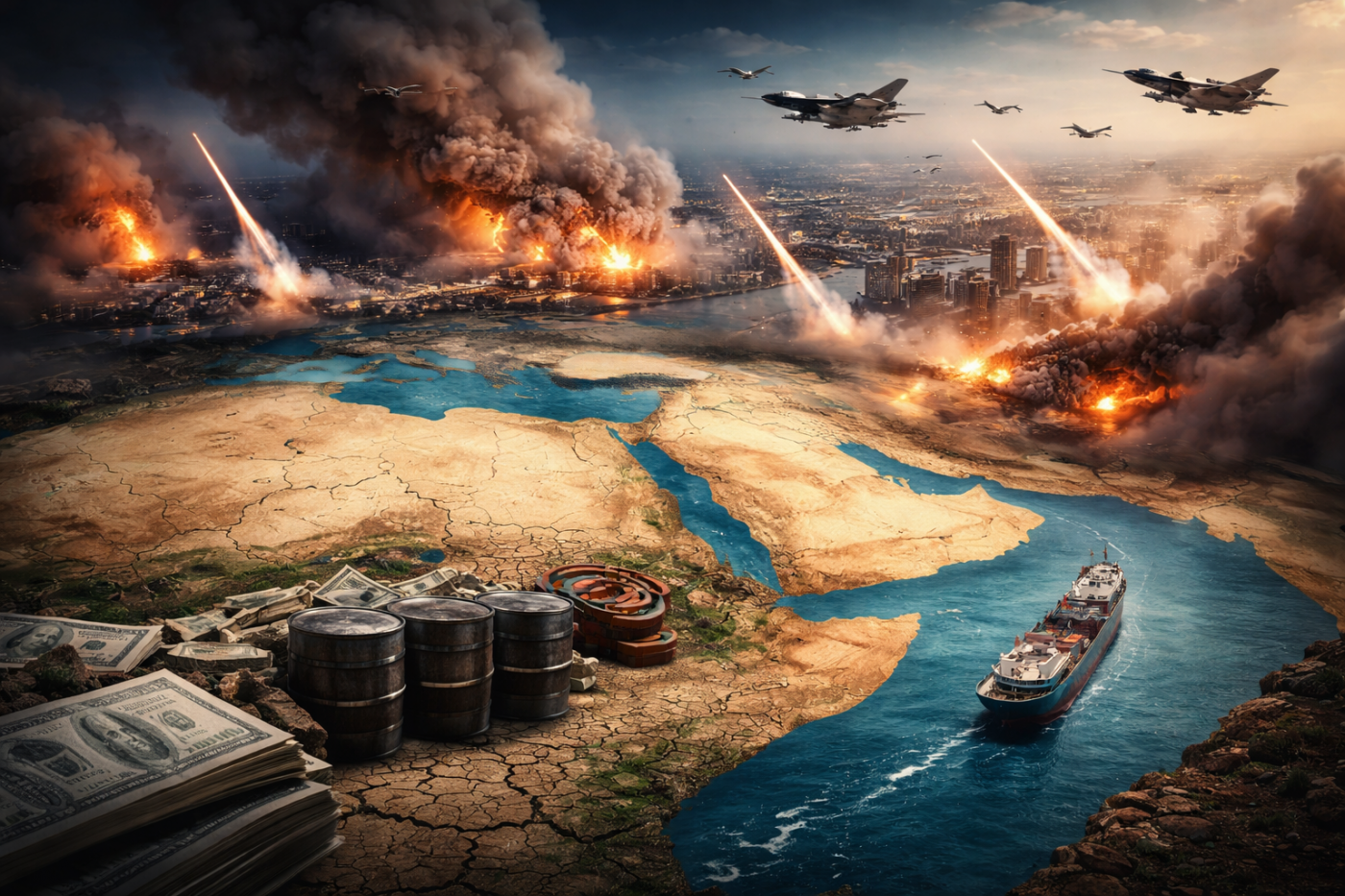
In recent days, an unprecedented military escalation has unfolded, marked by coordinated U.S.–Israeli strikes against targets inside Iran. These strikes were followed by direct and indirect Iranian responses, ushering the region into a new phase of open confrontation between Iran on one side, and both the United States and Israel on the other.
The current escalation goes beyond the “shadow war” pattern that has characterized recent years and threatens to evolve into a broader regional conflict with far-reaching implications for global energy markets, maritime corridors, and non-traditional networks of influence across Asia and Africa.
Although geographically distant from the immediate theater of operations, Africa stands at the center of the conflict’s indirect repercussions through three primary vectors:
-
Economic–Energy Impact: Disruptions to oil prices and shipping routes.
-
Security–Geopolitical Impact: Repositioning of international powers in the Red Sea and the Horn of Africa.
-
Political–Alignment Pressures: Growing pressure on African states to align with competing international blocs.
II. Nature of the Strikes and Strategic Objectives
Preliminary indicators suggest that the U.S.–Israeli strikes targeted:
-
Facilities linked to Iran’s nuclear program.
-
Missile sites and air defense systems.
-
Logistical infrastructure connected to Islamic Revolutionary Guard networks in the region.
The apparent strategic objectives include:
-
The potential collapse or destabilization of the Iranian regime.
-
Slowing or disrupting Iran’s nuclear progress.
-
Undermining Tehran’s capacity to manage a multi-front regional confrontation.
-
Reimposing a new deterrence equation following the erosion of previous rules of engagement.
In response, Iran appears to be adopting a “composite retaliation” strategy that includes:
-
Direct missile or drone launches.
-
Activation of regional allies and proxy networks.
-
Applying pressure on vital maritime chokepoints.
III. Possible Scenarios
1. Rapid Containment Scenario
-
Limited reciprocal strikes.
-
International mediation efforts.
-
A return to the “shadow war” model.
Likelihood: Moderate, contingent upon intervention by major powers to freeze escalation.
2. Broad Regional War Scenario
-
Engagement across multiple fronts (the Gulf, Lebanon, Syria, Iraq, and the Red Sea).
-
Direct targeting of maritime navigation in the Strait of Hormuz.
-
Expanded U.S. military involvement.
Likelihood: Plausible if escalation continues unchecked.
3. Prolonged War of Attrition Scenario
-
Intermittent strikes over several months.
-
Intensification of asymmetric operations.
-
Mutual economic exhaustion.
Likelihood: High, given the structural nature of the confrontation and the relative balance of deterrence.
IV. Economic Impacts on Africa
1. Oil Prices and Energy Markets
Iran is a significant actor in global energy markets. Any disruption in the Gulf region immediately affects global oil prices.
Oil-importing African countries are likely to face:
-
Increased import bills.
-
Pressure on local currencies.
-
Rising inflation rates.
Conversely, oil-exporting African states may benefit relatively from higher prices, though gains could be offset by logistical disruptions in global shipping.
2. Maritime Routes and the Red Sea
Escalation in the Gulf or the Red Sea threatens global trade flows through:
-
The Strait of Hormuz.
-
Bab el-Mandeb.
-
The Suez Canal.
States directly affected include:
-
Egypt (Suez Canal revenues).
-
Djibouti (military bases and port services).
-
Sudan (strategic Red Sea coastline).
Any decline in maritime traffic would reduce national revenues and raise import costs.
V. Security and Military Dimensions in Africa
1. The Horn of Africa and the Red Sea
Iran has historically maintained indirect activity in this region, including alleged arms networks and political influence channels.
Escalation could prompt Tehran to:
-
Expand its discreet presence in parts of the Sahel and the Horn of Africa.
-
Utilize the Red Sea as a strategic pressure lever.
In response, the United States and Israel may intensify naval and intelligence deployments in the region, raising overall militarization levels.
2. The Sahel and West Africa
In recent years, Iran has sought to cultivate economic and security ties with certain Sahel states. Under mounting pressure, Tehran may attempt to expand these relationships as alternative strategic depth.
This dynamic risks turning parts of Africa into arenas of intelligence and proxy competition between rival international blocs.
VI. Political and Diplomatic Repercussions
1. Alignment Pressures
African states—particularly those with economic ties to Iran or the United States—may face diplomatic pressure to adopt clearer positions in international forums.
2. The Role of the African Union
The African Union may confront a significant diplomatic test, especially if Red Sea states are directly affected or if regional instability escalates.
3. Implications for Sudan and the Horn of Africa
Given the fragile internal situation in Sudan, any additional regional entanglement could further complicate its political and security landscape—particularly if ports or territories become implicated in broader geopolitical competition.
VII. Implications for African Food Security
-
Rising energy prices increase transportation and fertilizer costs.
-
Disruptions to global supply chains.
-
Greater fiscal pressure on government subsidy programs.
Highly fragile economies would be most vulnerable, potentially leading to social unrest in certain contexts.
VIII. Overall Strategic Assessment
-
The conflict is likely to evolve into a prolonged war of attrition.
-
Africa will not be a primary battlefield but will experience significant secondary effects.
-
African Red Sea states are the most exposed to direct risks.
-
Higher energy prices may create short-term gains for oil exporters but carry broad inflationary risks.
-
International competition in Africa may accelerate under the umbrella of this conflict.
Conclusion
The U.S.–Israeli strikes against Iran represent a turning point in regional deterrence dynamics. While the primary theater of confrontation remains in the Middle East, Africa stands on the indirect fault line of the conflict through energy markets, maritime security, and great-power competition.
The strategic challenge facing African capitals is not only to absorb economic shocks but also to carefully manage diplomatic balance among major powers—preventing the continent from becoming an alternative arena for a conflict that does not serve its long-term strategic interests.