
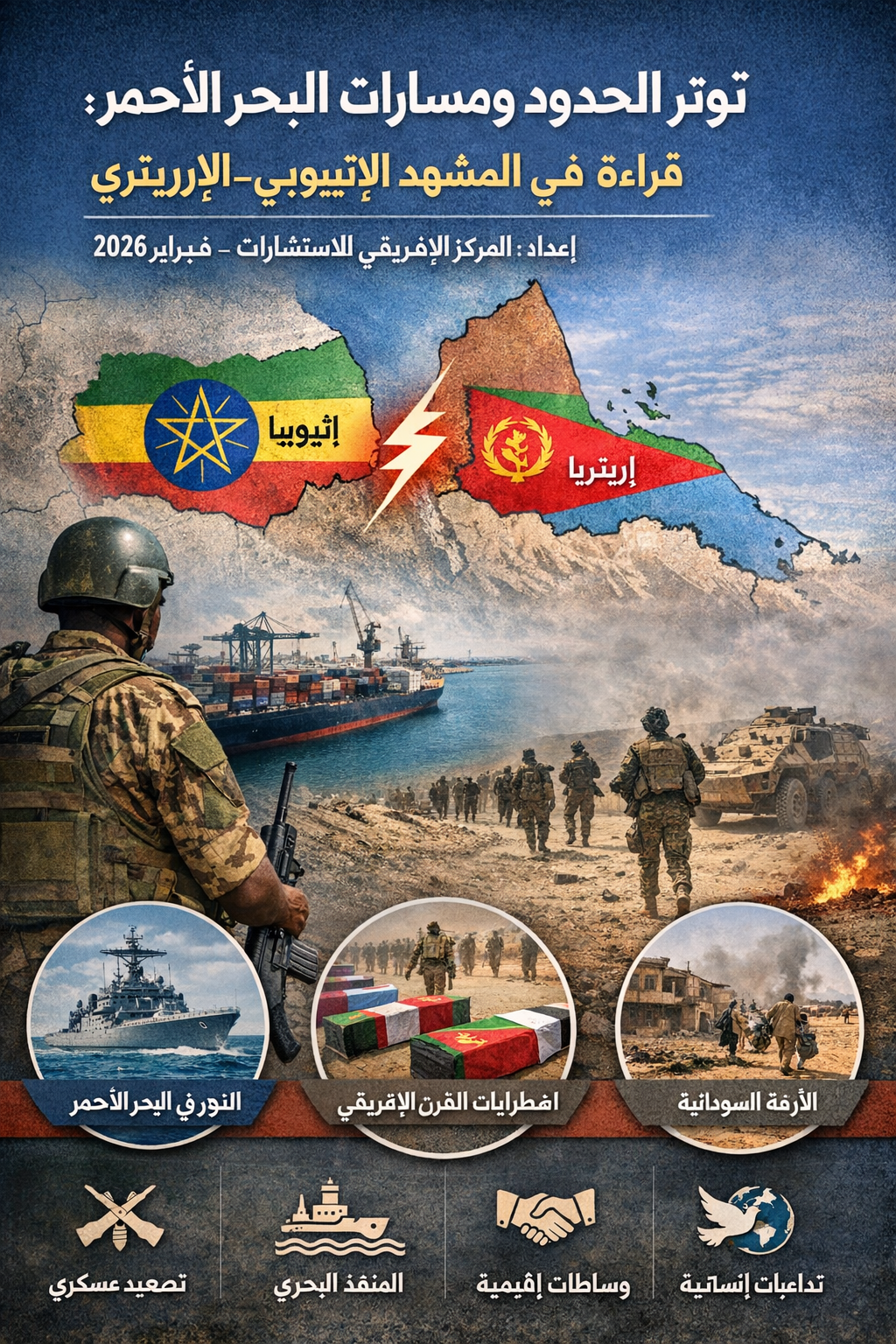
African Center for Consultancy – February 2026
- Executive Summary
Relations between Ethiopia and Eritrea are witnessing an unprecedented military escalation since the signing of the 2018 peace agreement, with reports of mutual troop deployments and intensified Ethiopian political rhetoric framing access to a seaport as an “existential necessity.”
This escalation unfolds amid growing internal fragility within Ethiopia (Oromia, Amhara, and Tigray), complex regional balances in the Red Sea and the Horn of Africa, and the potential involvement of regional actors backing both Addis Ababa and Asmara.
This assessment estimates that the likelihood of direct military confrontation within the next six months is moderate to high. However, the trajectory will largely depend on the scale of international and regional pressure, as well as the ability of mediators at both regional and international levels to impose a negotiating track capable of preventing a slide into a broader regional conflict.
- Brief Historical Background
Eritrea gained independence from Ethiopia in 1993 after a prolonged liberation struggle. However, the border war between the two countries (1998–2000) resulted in tens of thousands of casualties, and tensions persisted until the historic 2018 peace agreement between Ethiopian Prime Minister Abiy Ahmed and Eritrean President Isaias Afwerki.
The Tigray conflict (2020–2022) remilitarized bilateral relations, as Eritrean forces intervened in support of the Ethiopian federal government against the Tigray People`s Liberation Front (TPLF), creating a temporary tactical alliance between Addis Ababa and Asmara. However, the end of the war did not produce a comprehensive strategic settlement, instead generating new contradictions, including:
- Continued Eritrean troop presence in parts of Tigray.
- Asmara’s exclusion from post-war political arrangements.
- The revival of Ethiopian rhetoric regarding a “sovereign maritime outlet.”
III. Drivers of the Current Escalation
- The Maritime Access Dilemma
Ethiopia lost direct access to the sea following Eritrea’s independence and now relies on Djibouti’s ports for over 90% of its trade. Since 2023, Abiy Ahmed has escalated his discourse describing access to the Red Sea as an “existential necessity,” with repeated references to the Eritrean port of Assab.
Domestically, this narrative has gained popular traction and is being used as a mobilization tool similar to the rhetoric surrounding the Grand Ethiopian Renaissance Dam. However, it constitutes a direct challenge to Eritrean sovereignty and undermines established principles of international law.
- Mutual Accusations of Supporting Insurgencies
- Addis Ababa accuses Asmara of supporting armed movements in Amhara and Oromia.
- Eritrea perceives Ethiopia’s regional posture as an attempt to reshape the Horn of Africa’s balance of power at the expense of smaller states’ sovereignty.
- The Regional Dimension
Any confrontation is unlikely to remain bilateral. It would intersect with:
- The Sudanese crisis and its evolving alignments.
- Rising tensions in the Red Sea corridor.
- Competition over influence in Somalia and Somaliland.
- The roles of regional powers such as Turkey, Saudi Arabia, and the UAE.
- Strategic Calculations of the Two Sides
- Abiy Ahmed’s Calculations
- Consolidating the Domestic Front:
Leveraging the maritime access issue to transcend ethnic and political divisions. - Reframing Legitimacy:
Linking regime survival to achieving a historic breakthrough on Red Sea access. - Severe Economic Risks:
The Tigray war cost Ethiopia over $28 billion and weakened its debt restructuring trajectory. Any renewed confrontation would further derail economic recovery efforts. - Betting on Regional Support:
Addis Ababa appears to rely on a network of military and economic partnerships capable of providing logistical and intelligence backing.
- Isaias Afwerki’s Calculations
- Primacy of Sovereignty and Survival:
Asmara views any maritime concession as a precedent threatening its independence. - Deterrence Strategy:
Maintaining pressure along the Tigray frontier to constrain Addis Ababa. - Counterbalancing Alliances:
Strengthening ties with regional actors concerned about Ethiopia’s expanding influence.
- Scenarios for the Coming Months
Scenario One: Controlled Escalation
- Continued military mobilization.
- Limited border skirmishes.
- Active regional mediation.
- Avoidance of full-scale confrontation.
Scenario Two: Limited Multi-Front Confrontation
- Direct border clashes.
- Engagement of forces in Tigray and Amhara.
- Logistical involvement by regional actors.
- Disruptions in the Red Sea corridor.
Scenario Three: Open Regional Conflagration
- Direct involvement of external actors.
- Closure or disruption of maritime routes.
- Collapse of Ethiopia’s debt restructuring process.
- Large-scale regional displacement.
Scenario Four: Diplomatic Breakthrough
- Interim agreement on troop withdrawals from flashpoints.
- Economic understanding on port usage without infringing sovereignty.
- Establishment of a joint international monitoring mechanism.
- Potential Implications
- On Sudan
Direct overlap with the ongoing conflict, with potential use of the Sudanese theater as a pressure lever.
- On the Red Sea
Increased militarization of maritime routes and threats to global energy and trade security.
- On the African Union
A serious test of its conflict-prevention mechanisms amid recurring accusations of institutional ineffectiveness.
- Humanitarian Impact
Risks of new displacement waves and further collapse of essential services.
VII. Early Warning Indicators
Key developments to monitor include:
- Unusual movements around the Assab base.
- Intensified domestic mobilization rhetoric in Addis Ababa.
- Logistical deployments by regional actors into the Horn of Africa.
- Suspension or freezing of Ethiopia’s debt restructuring negotiations.
VIII. Recommendations
- Advocate for a joint international monitoring mechanism to oversee disengagement from flashpoints and reduce military escalation.
- Decouple the maritime access file from military tracks and reframe it within a long-term cooperative economic framework.
- Launch a regional Red Sea initiative aimed at regulating maritime security arrangements.
- Strengthen urgent humanitarian corridors under international supervision.
- Prevent the militarized internationalization of the crisis and discourage direct regional or global involvement.
Conclusion
The region stands at a critical strategic crossroads. A renewed confrontation between Ethiopia and Eritrea would not merely replicate a traditional border dispute but could evolve into a complex regional crisis intersecting with tensions in the Red Sea, Sudan, and Somalia, potentially reshaping the Horn of Africa’s balance of power for years to come.
Containment remains possible, but it requires political will that transcends short-term tactical calculations. Given the pattern of contradictory rhetoric and calibrated escalation, the coming months will serve as a decisive test of the region’s capacity to avoid a conflict it can ill afford.